A quick introduction, since this is our first. CIMA Risk is travel risk intelligence built around a single country, Colombia. We watch what is happening on the ground, from Bogotá out to the border zones, and turn it into plain, forward-looking guidance for the people whose plans depend on it: NGOs and humanitarian teams, journalists, corporate and executive travelers, consultants, and researchers. We started CIMA because Colombia tends to move faster than the reporting about it, and falling a week behind is how a manageable trip becomes an expensive one. Everything we publish follows the principles of ISO 31030 and ISO 31000 and stays strictly advisory. Here is the first read.
Most election planning braces for the wrong moment
Colombia chooses a president in a runoff on Sunday 21 June, de la Espriella against Cepeda. The instinct most security teams bring to an election is to harden for vote day, picturing crowds, marches, and trouble at the polls. It is a reasonable thing to expect, and for a Colombian presidential vote it is usually misplaced. Vote day tends to draw heavy coverage and a fairly quiet street, because people are voting rather than marching. The 2018 and 2022 votes were calm on the ground, and the first round on 31 May looked much the same.
The moment that matters is the count
An experienced Colombian hand will raise this first: the risk does not hold off for three days after the result. It can ignite on the night of the count, the moment a trailing campaign decides the math is turning against it and begins working its base in real time. That is not a theoretical worry this year. This is one of the closest races in recent Colombian memory, with a first-round margin under three points, and the contestation narrative is already circulating before the runoff has happened. President Petro has refused to recognize the first-round precount and has questioned the counting software, and Cepeda has spoken of ten million miscounted votes. We take no position on those claims, and neither should you. International observers, including the European Union mission, called the process transparent and found no fraud, and Colombia's electoral institutions remain credible. What matters for street risk is less whether fraud occurred and more whether a losing side claims it did, and how its supporters answer. This year, the conditions for that are unusually present.
The numbers carry the same message. The Misión de Observación Electoral (MOE), Colombia's most trusted independent election monitor, rates 81 municipalities at extreme risk for the runoff, a 65 percent jump over 2022. The people who watch Colombian elections for a living are saying plainly that this is not a normal cycle.
This cycle has not been an ordinary one
It opened with the assassination of a presidential contender. Senator Miguel Uribe Turbay was shot while campaigning in Bogotá in June 2025 and died of his wounds that August. We mention it once, and carefully. It is not here for shock. It is here because it is the backdrop the whole country carries into this vote, and because it explains why the security establishment is treating this period with such seriousness.
What the data can show, and what it cannot
Our charts draw on nine years of event data, and they hold a clear pattern. Recorded activity around a presidential vote tends to peak in the one to three days after the result, rather than on election day itself.
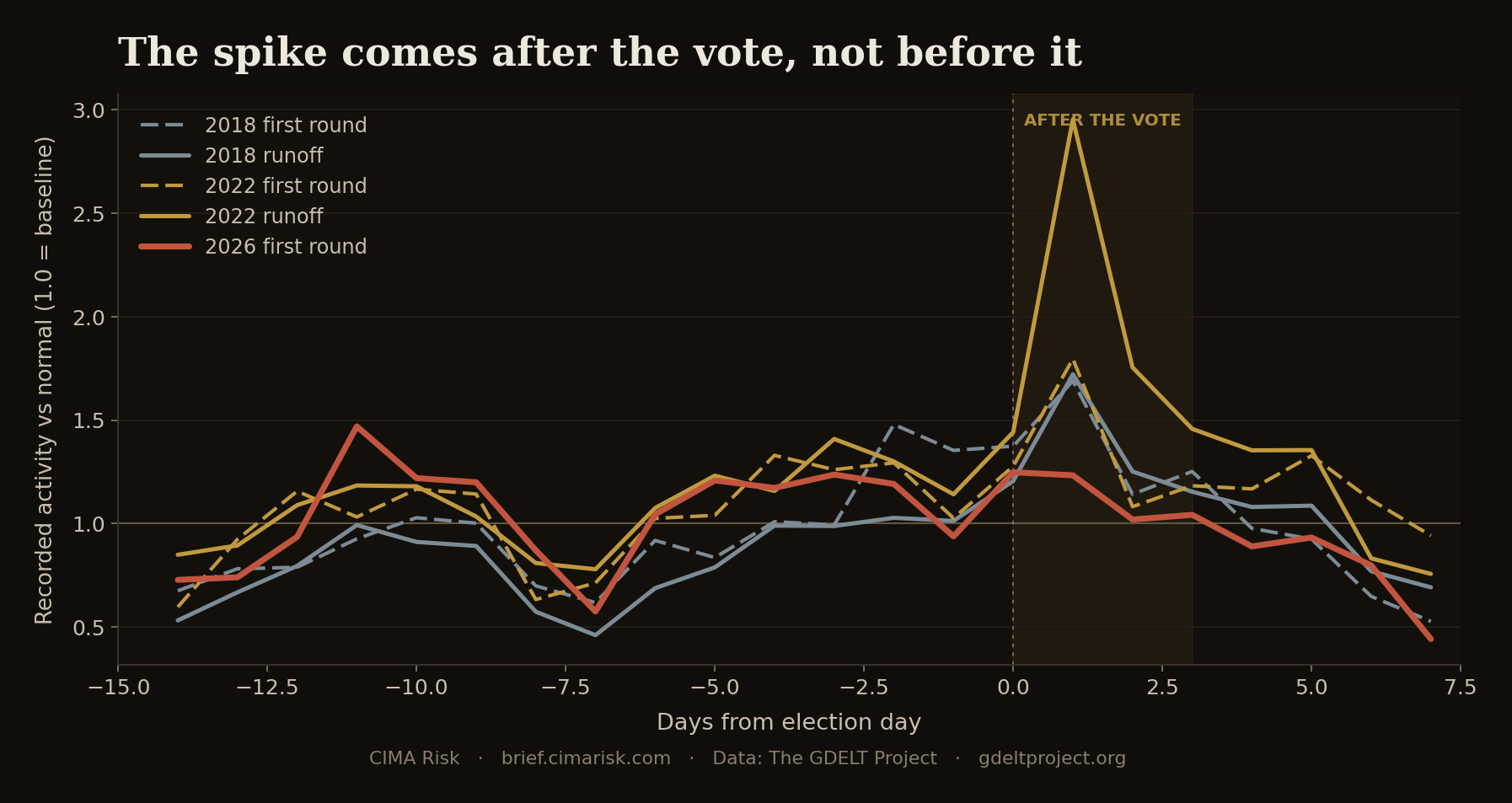
That pattern is real, and it is also, by its nature, partly blind. The data is daily and national. It cannot see a flare that begins at nine in the evening at a single intersection and is put down by midnight, so those count-night flashpoints get folded into the day after once the reporting catches up. Read the curve for magnitude rather than timing.
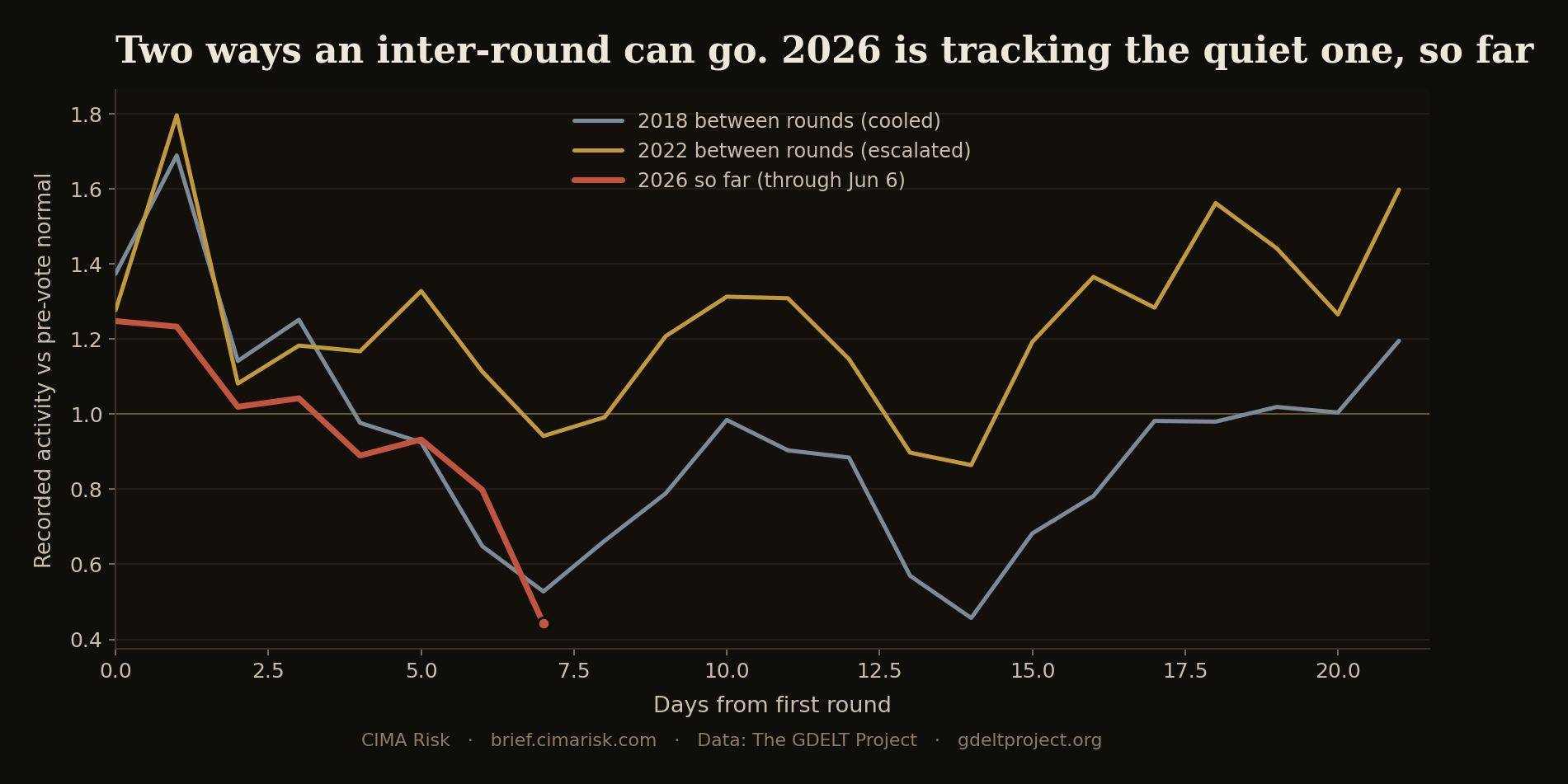
It is just as important not to mistake the quiet stretch between the two rounds for a forecast.
Where it lands, if it lands
The geography is more predictable than the timing. When a contested count has spilled into the street in Colombia, it has gone to the same places: the CAI police posts, Transmilenio and bus stations, and the polling sites, the points where the public meets the state. The reference point is the 2021 national strike, when dozens of CAI posts were attacked and more than a hundred Transmilenio stations were vandalized within days. That is the playbook, and the side most likely to feel aggrieved by a close 21 June count is also the one that has shown it can put people on the street.
The necessary caution
The likeliest outcome is still an orderly runoff followed, in time, by a concession, the way 2022 resolved. We are flagging a tail that is fatter than usual rather than predicting a fire. The right response is preparation rather than alarm: know where the flashpoints are, follow the count rather than the calendar, and keep your plans flexible from the evening of the 21st into the middle of the following week.
How to carry yourself in Bogotá
Most of this comes down to one habit, which is to avoid being caught flat-footed while you are moving. Vote day, 21 June, should be calm at street level, with the friction coming from security and election logistics, so the sensible move is to pad your timing. The window worth planning around opens with the count that night and runs into the early part of the following week. Where it actually touches a traveler:
- The airport corridor is your biggest exposure. El Dorado reaches the city on one spine, Avenida El Dorado, which is Calle 26, and that road runs straight past the Universidad Nacional flashpoint at Carrera 30 (the NQS). Give every airport run a wide time buffer, make sure your driver knows the alternates off Calle 26, and if the corridor is in a go-slow (plan tortuga), assume a tight departure is already lost and rebook rather than gamble.
- The Universidad Nacional corner, Carrera 30 at Calle 26, is the spot to route around. Clashes here involve fire and tear gas and tend to close the Transmilenio stations beside them. If you are crossing the city from east to west, plan a way past it.
- Downtown, the magnet is the Plaza de Bolívar. Bogotá's large marches converge on the historic square in La Candelaria, usually staging up from the Parque Nacional along Carrera 7. If your trip includes the historic center, and most first visits do, check the day's calendar before you go and stay clear of the square when a march is called.
- In the north, watch the portals and the Autopista Norte. If you are in the northern hotel and business districts, the nearest staging points are Portal Norte and the Autopista Norte at Calle 170. Citywide, the Transmilenio portals take the worst of it when things turn, so on a tense day the system is often the first thing to shut down, and you should not count on it as your way out.
- General posture. Keep clear of CAI police posts, the major Transmilenio interchanges, and any polling concentration once voting closes on the 21st. Expect a dry-law (ley seca) window and heavier checkpoints around the vote. Carry more time than you think you need, keep your phone charged and your route in your head, and treat the evening of the count as a night to already be where you are sleeping.
What this is, and what it is not
These are patterns, not predictions, drawn from years of public data we took the time to source and vet, set against our own collection inside Colombia and the experience we have built there. Patterns are tendencies rather than laws, and we would rather say that plainly than claim a certainty no one has. We do not take political sides, and we do not adjudicate anyone's fraud claim. Our work is narrower and more useful: to tell you where the risk is likely to sit, and when, so your week holds together.
This read centers on Bogotá. Our weekly Risk Brief covers the full runoff window across Colombia, city by city and corridor by corridor, at brief.cimarisk.com.
A few terms
plan tortuga (go-slow): A deliberate crawl by drivers or marchers that chokes a road without formally blocking it.
ley seca (dry-law): A temporary ban on alcohol sales, routinely decreed around Colombian elections.
CAI (Comando de Atención Inmediata): The small neighborhood police posts found across Colombian cities, and recurring flashpoints during unrest.
Carrera 30 / NQS: Bogotá's main north-south arterial, also called Avenida Ciudad de Quito.
Sources and data. Charts built from event data published by The GDELT Project (gdeltproject.org). Runoff risk levels from Colombia's Misión de Observación Electoral. Further analysis and on-the-ground collection by CIMA Risk.