A field note on the most predictable risk pattern on the Colombian calendar this June.
Colombia goes to the polls on Sunday, 21 June. Two days later, on Tuesday, 23 June, the national team plays its second World Cup match. Two events that empty the same streets and fill the same plazas, stacked inside a single week. For anyone responsible for moving people or assets in Colombia, that week is worth reading before it arrives.
A national-team match is one of the few moments when an entire country becomes predictable.
The pattern repeats every tournament. In the hour before kickoff, traffic thins and commercial districts go quiet as the country moves indoors and into bars. Any venue with a screen, really. During the match, the streets are unusually empty. At the final whistle, the day turns on the result. A win sends crowds into the avenues with caravans, horns, flags, and fireworks: La Séptima in Bogotá, La 70 beside the stadium in Medellín, La Sexta in Cali. A loss empties them quickly and the mood turns inward. Either way the movement is concentrated, loud, and easy to anticipate.
Concentrated crowds are not a threat. They are a planning input.
Three things shift on a match evening. Movement windows compress: the quiet hour to cross a city is during the match, not after it. Celebration epicenters become crowd-density and opportunistic-theft zones for a few hours, and they are known in advance. During the 2024 Copa América final, Bogotá put roughly 15,000 people in Parque de la 93, more than 35,000 in Parque Simón Bolívar, and filled the Movistar Arena for a free screening, with 2,500 police assigned across those sites. And public security redeploys toward crowd management, which thins coverage elsewhere. None of this is cause for alarm. All of it is plannable.
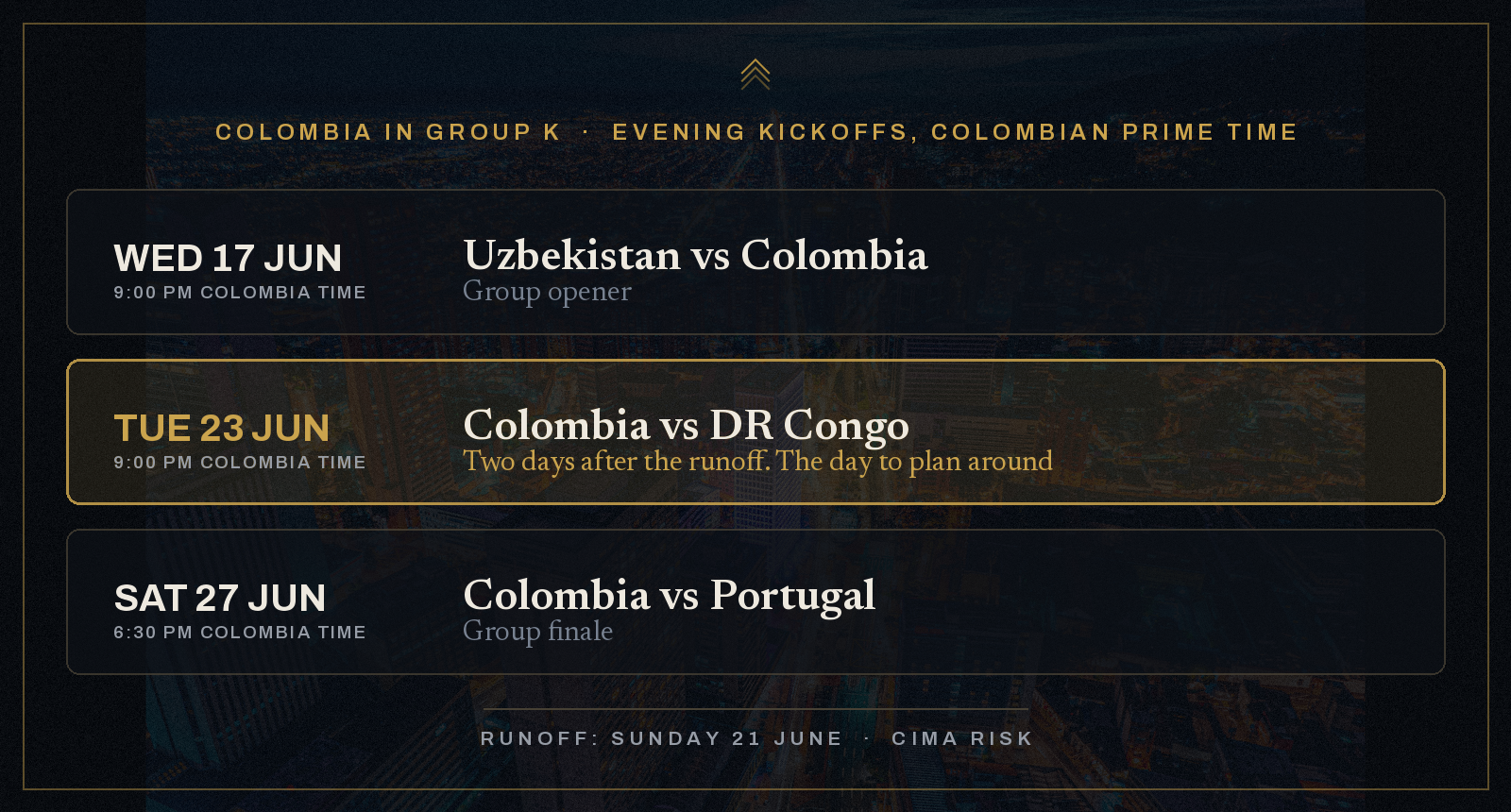
The 23 June match is the one to plan around.
It falls two days after the presidential runoff, while the country is still processing the result. Both campaigns have spent the run-up accusing the other side of trying to steal the vote, so the temperature of that processing is not in doubt. Kickoff comes roughly 48 hours after the polls close. Football crowds and political feeling will share the same plazas on the same evening. That overlap predicts no incident. It does mean the day carries two sources of energized, concentrated crowds at once, and it deserves more deliberate movement planning than an ordinary Tuesday.
This is the value of reading the calendar early. Surprises get the headlines. Most of what shapes a safe week in Colombia is not a surprise: it is visible weeks out, written into the fixture list and the electoral calendar, and heard on the street by anyone close enough to listen. When Colombia plays, plan around it.